
AI GCC: Why Global Companies Are Building AI Capability Centres in India?
🕑 4 min read | 📂 Enterprise AI | 🎯 For CTOs, HR Leaders, L&D Heads
AI GCC is quickly becoming more than another technology buzzword. As artificial intelligence moves from experimentation into real business operations, global companies are rethinking where and how they build their AI capabilities. For many enterprises, the answer increasingly points toward India.
India's Global Capability Centres (GCCs) have already moved far beyond their traditional role as offshore support and cost-optimization units. They are now involved in product engineering, research and development, data science, cybersecurity, cloud, automation and increasingly, artificial intelligence. Current industry estimates put India's GCC ecosystem at more than 2,100 centres employing around 2.36 million professionals and generating nearly $100 billion in annual revenue.
At the same time, AI adoption is accelerating. EY's 2025 GCC Pulse Survey found that 58% of India-based GCCs were already investing in Agentic AI, while another 29% planned to scale their investments within the following year.
This convergence is creating a new model: the AI-focused Global Capability Centre.

What Is an AI GCC?
So, what is AI GCC in practical terms?
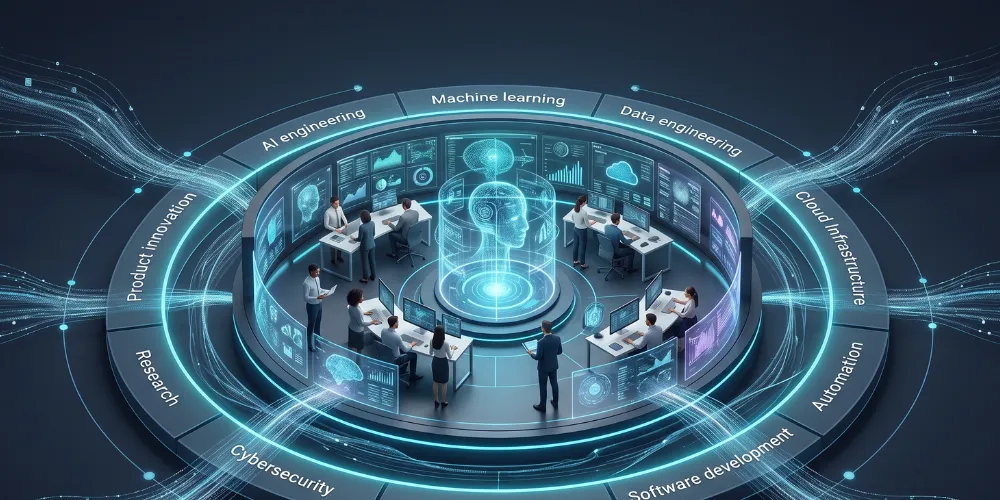
An AI GCC is a Global Capability Centre designed or expanded specifically to build, deploy and scale artificial intelligence capabilities for a company's global operations. Instead of focusing primarily on support functions, an AI-focused GCC can bring together AI engineers, data scientists, ML engineers, software developers, domain experts, product teams and automation specialists.
The AI GCC full form can therefore be understood in the context of an AI-focused Global Capability Centre.
The exact structure varies from company to company. One organisation may use its centre for AI research and model development, while another may focus on enterprise automation, computer vision, intelligent document processing, data platforms, AI agents or AI-enabled products.
The common thread is ownership.
A modern GCC is increasingly expected to create intellectual property, solve complex business problems and contribute directly to global product and technology strategies - not simply execute instructions from headquarters.
Why Are Global Companies Building AI Capability Centres in India?
The reasons go beyond lower operating costs.
1. Access to a Large Technology Talent Pool
India has built one of the world's largest technology talent ecosystems. This gives global enterprises access to engineers and specialists across software development, data engineering, machine learning, cloud computing, cybersecurity and AI.
More importantly, the nature of demand is changing.
Companies are no longer looking only for large engineering teams. They are looking for people who can work across disciplines - AI, software, data, product and business operations.
This is one reason India's GCC ecosystem is shifting from a headcount-driven model toward a capability-driven model. PwC's recent analysis describes Indian GCCs as increasingly important platforms for AI research, advanced analytics, product engineering and enterprise transformation.
2. AI Development Requires More Than Buying an AI Model
Businesses quickly discover that implementing AI is not simply a matter of subscribing to an API.
An enterprise AI system needs data pipelines, model integration, application development, security, monitoring, governance and domain-specific workflows.
That is where an AI GCC solution can become strategically valuable.
A dedicated team can work on the entire AI lifecycle - from identifying use cases and preparing data to developing models, integrating AI into existing systems and continuously improving production deployments.
For global companies, having these capabilities within a dedicated centre can create tighter coordination between engineering, business teams and AI initiatives.
3. India Is Moving From Execution to Ownership
The biggest change in the GCC story is arguably this shift from execution to ownership.
Earlier, a company might establish a centre in India to manage application maintenance, finance operations, customer support or other shared services.
Today, Indian GCCs are increasingly involved in product development, R&D, advanced analytics, AI and global decision-making.
NASSCOM's reporting on India's GCC ecosystem highlights this evolution, noting that many centres are now taking ownership of end-to-end product lifecycles and high-value technology functions. That makes an AI capability centre fundamentally different from a traditional outsourcing model.
The question is no longer, "How much work can we move to India?"
It is becoming, "What strategic technology capabilities can we build in India?"
The Rise of Agentic AI GCC Models
Generative AI was the first major wave. The next one is increasingly agentic AI.
Traditional enterprise software generally waits for users to initiate actions. AI agents can potentially reason through tasks, interact with systems, make decisions within defined boundaries and execute multi-step workflows.
This is particularly relevant to GCCs because many of them already sit at the intersection of technology, business processes and enterprise data.
EY's 2025 research found that 58% of India-based GCCs were investing in Agentic AI, while 29% planned to scale investment over the following year.
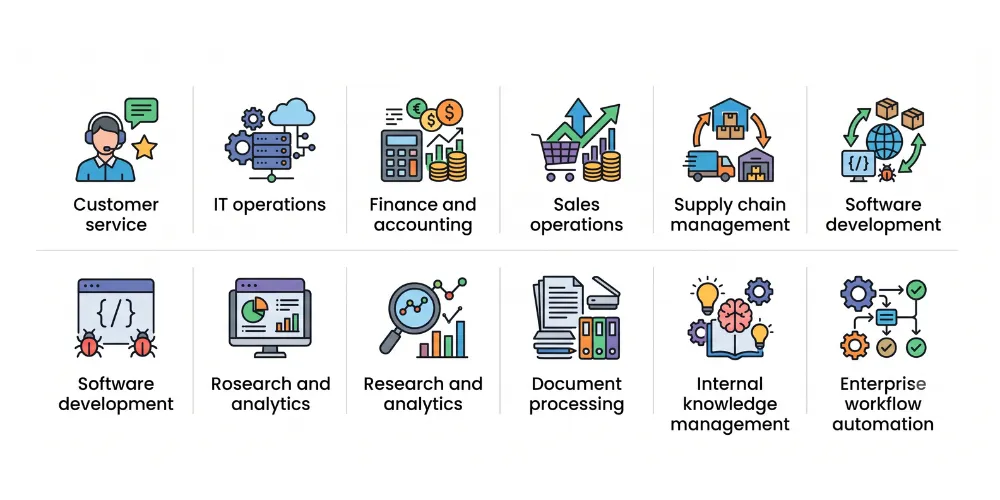
An agentic AI GCC could therefore become a central environment for building and testing AI agents for functions such as:
The important point is that agentic AI is not valuable simply because it is autonomous. Its value comes from connecting intelligence with real business workflows.
What Does an AI GCC Actually Build?
The scope of an AI capability centre can be surprisingly broad.
Depending on the organisation, an AI GCC service model can include:
[1] AI and Machine Learning
Teams can develop, fine-tune, evaluate and deploy machine learning models for specific business requirements.
[2] Generative AI
GCC teams can build enterprise applications around large language models, retrieval-augmented generation, private knowledge bases and AI-powered assistants.
[3] AI Agents and Automation
AI agents can be integrated with enterprise applications to automate repetitive or multi-step processes.
[4] Computer Vision
Manufacturing, logistics, healthcare, retail and other industries can use computer vision for inspection, detection, monitoring and visual analytics.
[5] Intelligent Document Processing
Documents remain one of the largest sources of unstructured business information. AI systems combining OCR, document understanding and machine learning can turn invoices, engineering documents, forms and reports into structured information.
This is an area where AI India Innovations has practical experience. The company's Computer Vision capabilities include structured OCR and Document AI, while its engineering-focused AI work includes extracting structured information from complex P&ID drawings using Computer Vision and OCR.
[6] Data and AI Infrastructure
An AI centre also needs the foundation beneath the models: data pipelines, cloud infrastructure, APIs, databases, monitoring, security and deployment architecture.
Without this foundation, AI pilots can remain disconnected from experiments instead of becoming useful production systems.
Why India Instead of Simply Building AI Teams at Headquarters?
This is where the GCC model becomes interesting.
A global company could simply hire an AI team in its home market. But building a dedicated capability centre in India can provide a broader combination of talent, engineering scale and operational continuity.
India's GCC ecosystem also offers established technology clusters across Bengaluru, Hyderabad, Pune, Chennai, Delhi-NCR and other emerging locations.
NASSCOM reported more than 16 new GCCs in India in Q1 2025 alone, with new centres coming from North America, Europe and APAC and spanning industries including software, BFSI, healthcare, travel and professional services.
The geographic story is also changing. Increasing competition for talent in traditional hubs is pushing companies to consider emerging locations and Tier-II ecosystems. Government and industry initiatives are explicitly encouraging GCC expansion beyond the largest metropolitan centres.
That creates an important advantage: companies can think about where the right capability can be built, rather than automatically putting every function in the same city.
AI GCC Is Not Just About Cost Reduction
This is perhaps the most important distinction for companies evaluating the model.
Cost arbitrage may have helped create India's GCC industry, but it is increasingly not the primary reason companies are investing.
The new value proposition is built around:
Talent + Engineering + Innovation + Domain Expertise + Scale
The Biggest Challenge
As demand for advanced AI, data and engineering skills increases, competition for experienced professionals also increases. Reuters reported that India's GCC ecosystem is facing talent shortages and rising salary pressure as companies compete for advanced technology capabilities.
There are also other challenges:
- AI security and model risk
- Data privacy and governance
- Integration with legacy systems
- Infrastructure and compute requirements
- Intellectual property protection
- Leadership alignment with headquarters
- Continuous AI upskilling
- Measuring business value rather than AI activity
This means companies cannot build a successful AI GCC simply by hiring developers. The centre needs clear ownership, measurable business outcomes, governance, technology architecture and a close relationship with global leadership.
The Future of AI Capability Centres
The next phase of GCC development will likely be less about creating large teams and more about creating high-value AI capabilities.
AI itself may change the economics of GCC operations. Instead of continuously increasing headcount to increase output, organisations can use AI and automation to allow smaller, highly skilled teams to deliver significantly more.
This creates an interesting paradox.
AI may reduce the need for repetitive work inside GCCs while simultaneously increasing the strategic importance of highly skilled GCC teams.
Research from ORF similarly argues that AI is likely to make mature GCCs more strategically important because human oversight, specialised knowledge and complex decision-making remain necessary - even as the overall workforce becomes more productive and specialised.
The result could be a new generation of GCCs built around AI engineering, product ownership, intelligent automation and domain-specific innovation.
AI GCC: From Offshore Centre to Global AI Engine
The evolution of India's GCC ecosystem tells a much bigger story about how global companies are approaching artificial intelligence.
The first generation of GCCs was largely about efficiency.
The next generation was about technology and digital transformation.
The emerging generation is about capability ownership.
Companies are building teams that can research AI, engineer AI products, integrate intelligent systems into business processes and continuously improve them.
India is particularly well positioned for this transition because its existing GCC ecosystem already combines technology talent, engineering experience, enterprise exposure and a growing AI ecosystem.
That is why the conversation around AI GCC India is becoming increasingly relevant not only to companies operating in India, but also to global organisations looking for scalable ways to build AI capabilities.
How Logassa & AI India Innovations Can Support Your AI GCC Strategy
Building an AI capability centre does not necessarily mean developing every AI component completely in-house from day one.
Many organisations need specialised technology partners to validate use cases, build initial solutions, integrate AI into existing systems and establish the technical foundation before scaling internally.
Logassa LLC and AI India Innovations works with enterprises on customized AI and data solutions across areas such as Generative AI, Agentic AI, Computer Vision, Data Engineering, Speech AI and automation. Its experience also extends to practical applications such as OCR and intelligent document processing, where AI can convert complex business documents and visual information into usable structured data.
For companies evaluating an AI GCC strategy, this type of partnership can help bridge the gap between AI strategy and production implementation - from identifying high-value use cases and developing proof-of-concepts to deploying scalable AI solutions within existing enterprise environments.
The bigger opportunity is not simply to build another technology centre.
It is to build a capability that can contribute to the company's global AI roadmap.

Conclusion
The rise of the AI GCC reflects a fundamental change in how global enterprises think about technology talent and innovation. India is no longer being considered only for operational scale; companies are increasingly looking at the country to build AI engineering, product, R&D and automation capabilities that can serve global markets. The growth of Agentic AI, enterprise automation and intelligent document processing is likely to accelerate this shift further.
For organisations exploring this transition, the challenge is turning the idea into working technology. AI India Innovations can support that journey with customized AI development, Computer Vision, OCR and Document AI, Generative AI, Agentic AI, Data Engineering and automation capabilities. Rather than treating an AI capability centre as simply another delivery function, the focus should be on building practical AI systems that solve real business problems and can scale with the organisation.