
AI Solutions for Healthcare:
GenAI & Agent Use Cases for Hospitals, Clinics & Health Companies
🕑 10 min read | 📂 Cloud | 🎯 For CTOs, Leaders, L&D Heads
Generative AI, AI agents and intelligent automation are moving quickly from experimental pilots to core infrastructure inside hospitals, clinics, diagnostic centers and healthcare companies. This guide walks through fifteen practical AI use cases for healthcare organizations, the capability stack required to deliver them reliably and the process we follow to take a use case from idea to a governed production deployment.

Healthcare Has a Data Problem, Not an Information Problem
Healthcare organizations generate more data today than at any point in history. Patient records, medical reports, diagnostic documents, insurance claims, prescriptions, referral letters, discharge summaries, laboratory reports, invoices and operational records are created continuously across hospitals, clinics, diagnostic centers and healthcare companies.
The challenge is no longer simply collecting healthcare data. The real question is:
How can healthcare organizations turn this information into useful intelligence while reducing administrative workload and improving operational efficiency?
This is precisely where generative AI, AI agents, retrieval-augmented generation (RAG), document intelligence, computer vision and intelligent automation create significant, measurable value - not as novelty features, but as infrastructure that removes friction from clinical and administrative work.
How AI Is Transforming Healthcare
Healthcare AI has moved well beyond traditional prediction models. Modern generative AI systems can understand medical and administrative documents, summarize large volumes of information, answer questions using enterprise knowledge, assist healthcare professionals, automate repetitive documentation, process insurance and claims paperwork, support patient-facing teams, search healthcare information in natural language, connect with enterprise systems, trigger workflows and route exceptions to the right human team.
AWS identifies healthcare generative AI applications spanning clinician task automation, medical imaging, clinical note generation, call-center assistance, prior authorization and claims processing - confirming that the opportunity is far larger than a single healthcare chatbot. It's an entire operating layer for the hospital.
AI Clinical Documentation Assistant (Ambient AI Scribe)
Turns doctor-patient conversations directly into structured, reviewable clinical notes.
Recovers hours of physician time per week that would otherwise go into manual charting.
Reduces after-hours documentation burden - a leading driver of clinician burnout.
Keeps a human doctor in the loop at every step, preserving clinical accountability.
This is why, when a hospital asks where to start its generative AI journey, this is usually the first recommendation: it produces a visible, felt improvement for clinicians within weeks and it builds the organizational trust needed to expand into higher-stakes use cases such as prior authorization or claims automation.
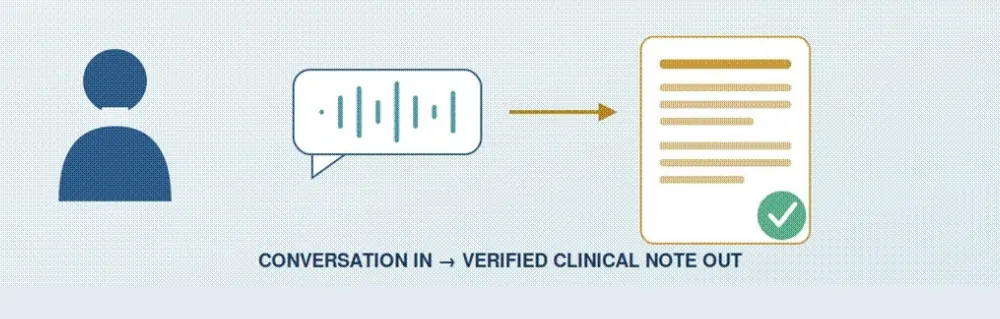
How the Workflow Works
The workflow is intentionally simple and keeps a human decision-maker at the final step:
– The doctor-patient conversation is captured through speech-to-text.
– AI processing applies clinical NLP to identify relevant medical content, structure and context.
– A draft clinical note is generated automatically in the hospital's preferred format.
– The doctor reviews, edits and verifies the note before it is finalized.
– The verified note is saved into the EHR, closing the loop.
Human review remains essential before any clinical documentation is finalized - the AI accelerates the first draft; it does not replace clinical sign-off.
Quick Wins vs. Strategic Bets
Not every use case should be tackled in the first quarter. A useful way to sequence the roadmap is to separate quick, low-risk wins from larger strategic investments that need more governance work up front.
| Category | Examples | Typical Time to Value |
|---|---|---|
|
Quick Wins |
Healthcare Chatbot, Patient Support Agent, Appointment Assistant, Call Center Assistant |
Weeks |
|
Fast |
Clinical Documentation Assistant, Clinical Document Summarization, Hospital Knowledge Assistant |
Weeks-Months |
|
Stratergic |
Prior Authorization Agent, Claims Processing, Insurance & TPA Automation, Multi-Agent Systems |
1 or more Quaters |
|
Specialized |
Diagnostic & Medical Imaging Assistance, Healthcare Research |
Quarters |
All 15 Generative AI & AI Agent Use Cases for Healthcare
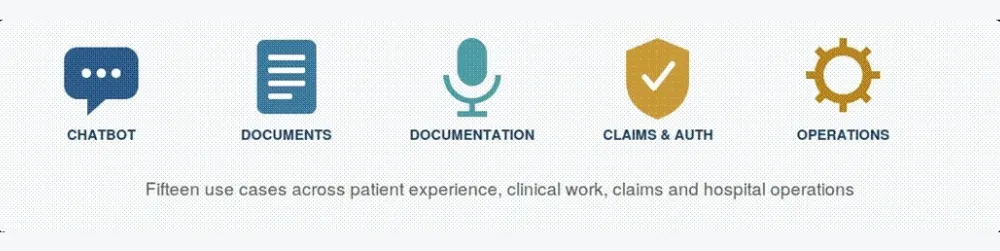
The spotlight above covers Use Case 6 in more depth. Here is the complete picture - the same use case is included below for completeness, alongside the other fourteen.
1. AI Healthcare Chatbot
The simplest entry point into generative AI for a hospital is a conversational assistant. A well-designed healthcare chatbot handles hospital services, doctor availability, department information, appointment processes, insurance queries, pre-visit instructions and hospital policies. The real value appears when the chatbot goes beyond static FAQs by connecting to authorized hospital systems so it can answer with live, contextual information rather than generic text.
2. AI Patient Support Agent
Patients constantly ask administrative questions: appointment details, registration guidance, department navigation, billing, insurance documentation, test preparation and follow-up instructions. A Patient Support Agent can retrieve the hospital's approved instructions and respond with a grounded, contextual answer - for example, telling a patient exactly what to bring for tomorrow's CT scan. This directly reduces the repetitive call volume handled by front-desk and call-center staff.
3. AI Appointment & Scheduling Assistant
Scheduling is one of the heaviest administrative burdens in any hospital. An AI scheduling assistant helps patients find the right department, understand appointment requirements, request or reschedule slots, receive reminders and understand preparation steps - while checking the authorized scheduling system in real time and routing complex or sensitive cases to a human.
4. AI Medical Document Processing
Hospitals process huge volumes of lab reports, discharge summaries, referral letters, prescriptions, insurance documents, patient forms, prior authorization files and diagnostic reports. AI-driven document intelligence extracts, validates and structures this information automatically, cutting manual data entry and accelerating downstream administrative workflows. AWS has demonstrated healthcare claims pipelines that combine Amazon Bedrock Data Automation with Bedrock AgentCore to extract claim information, validate it and transform it into FHIR resources within AWS HealthLake.
5. AI Clinical Document Summarization
The objective isn't to replace clinical judgment; it's to reduce information overload. AWS highlights summarization as a core healthcare generative AI use case and Forcura has used Amazon Bedrock to summarize lengthy patient referrals in production.
6. AI Clinical Documentation Assistant
This is the use case explored in depth in the spotlight section above - ambient AI scribing that turns doctor-patient conversations directly into structured, reviewable clinical notes.
7. AI Prior Authorization Agent
Prior authorization is notoriously document-heavy. AI agents can read medical records, extract relevant clinical information, identify missing documentation, summarize clinical evidence, match it against payer requirements and prepare a concise reviewer summary - with the final authorization decision remaining with qualified human reviewers. AWS specifically identifies prior authorization and claims automation as a target healthcare generative AI use case.
8. AI Healthcare Claims Processing
Claims processing involves claim forms, medical records, supporting documents, bills, authorization paperwork and provider information. AI can extract, validate, compare, summarize, flag missing information, route exceptions and transform everything into standardized formats. AWS has published a reference architecture that combines Bedrock AgentCore with AWS HealthLake to build an agentic healthcare claims pipeline end to end.
9. AI Insurance & TPA Automation
Insurers and third-party administrators can apply the same document intelligence patterns to claim classification, claim summarization, policy document search, hospital bill analysis, missing-document detection, case routing, customer communication and prior authorization support - freeing claims teams to focus on genuine exceptions instead of manually touching every file.
10. AI Hospital Knowledge Assistant
Every hospital sits on a mountain of internal knowledge: SOPs, clinical protocols, HR policies, department procedures, equipment manuals, administrative policies, training material and compliance documentation. A Retrieval-Augmented Generation (RAG) based Knowledge Assistant lets any staff member ask a natural-language question - such as the procedure for an equipment maintenance request - and receive an answer grounded in the hospital's own approved documentation.
11. AI Doctor / Clinician Co-pilot
A clinician-facing copilot provides one intelligent interface over authorized healthcare information: patient summarization, document and medical-literature search, protocol retrieval, documentation assistance, administrative help and case preparation. Positioned correctly, this is a decision-support and productivity tool - not a replacement for clinical oversight - that gives clinicians back time otherwise spent hunting through systems.
12. AI Diagnostic & Medical Imaging Assistance
Combining generative AI with computer vision opens up image preprocessing, anomaly detection, image classification and quality assessment, pathology image analysis, radiology workflow assistance, synthetic data generation for training and broader clinical decision support. AWS highlights medical imaging and pathology analysis - including anomaly detection and pattern recognition - as an established healthcare AI application area.
13. AI Call Center Assistant for Hospitals
Hospital call centers absorb thousands of repetitive interactions every week. An AI assistant can summarize patient information for the agent, surface knowledge recommendations, suggest responses, extract follow-up actions, search hospital policy in real time and reduce after-call documentation time - a use case AWS explicitly calls out for healthcare generative AI.
14. AI Pharmacy & Prescription Workflow Assistance
AI can support the administrative layer around pharmacy operations: prescription document extraction, medication information retrieval, pharmacy document processing, refill workflow assistance, drug-information knowledge assistants and inventory-related workflows - carefully scoped so the system never makes an unsafe clinical decision independently.
15. AI Hospital Operations Agent
Hospitals are businesses as well as clinical environments. Operational AI agents can support bed management, staff scheduling assistance, inventory monitoring, procurement, vendor communication, maintenance workflows, reporting and administrative analytics - for example, answering "which critical equipment maintenance requests are overdue?" by querying authorized hospital systems and returning a prioritized report.
The Architecture Behind These Use Cases
Nearly every use case above is powered by the same underlying capability stack. Amazon Bedrock provides the foundation model layer; AI agents (or AgentCore) orchestrate reasoning and tool use; document intelligence and computer vision extract meaning from unstructured content; workflow automation connects everything to n8n and APIs; and it all sits on top of the hospital's existing enterprise systems - always with a human review step before anything clinically or financially significant is finalized.
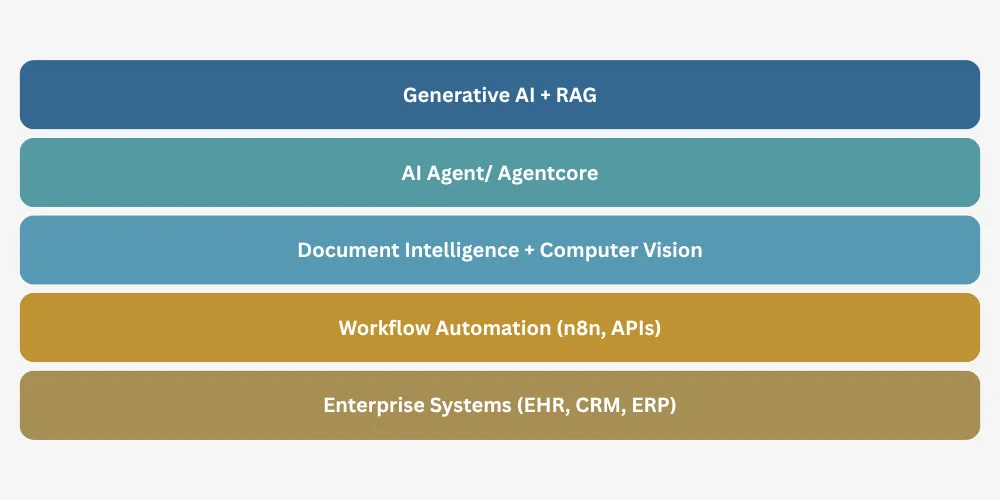
Healthcare AI Requires Trust, Not Just Technology
Healthcare is different from most other industries adopting AI. Patient information is highly sensitive and every system above must be designed with appropriate privacy, security, governance and regulatory requirements in mind. AWS states that its healthcare and life-sciences infrastructure supports healthcare security and compliance requirements, including HIPAA-eligible services.
A responsible healthcare AI deployment should be built around:
– Role-based access control
– Data minimization
– Encryption, in transit and at rest
– Audit logging
– Human-in-the-loop workflows
– AI guardrails
– Controlled tool access
– Ongoing monitoring and model evaluation
– Appropriate clinical validation
– Regulatory and organizational compliance
Healthcare AI Is Not About Replacing Doctors
The most valuable healthcare AI solutions are rarely designed to replace healthcare professionals. They are designed to remove unnecessary administrative work so professionals can spend more time on patients.
Before: Doctor → Search documents → Read reports → Prepare notes → Update systems
After: Doctor → AI Info retrieval → AI-generated draft → Doctor review → Final decision
Building Healthcare AI With Logassa LLC
Generative AI is creating a new opportunity for hospitals, diagnostic centers, healthcare SaaS companies, insurance providers, TPAs, pharmaceutical companies and research organizations. The opportunity is not simply to build a healthcare chatbot - it is to build intelligent systems that can understand, retrieve, summarize, reason, assist, automate and escalate.
Conclusion
Healthcare organizations do not have a shortage of data - they have a shortage of time to turn that data into action. The fifteen use cases covered here, from ambient clinical documentation to claims processing and hospital operations, all point to the same opportunity: pairing generative AI, AI agents, RAG, document intelligence and computer vision.
Logassa LLC helps hospitals, clinics, diagnostic centers and healthcare companies move these use cases from idea to a secure, production-ready deployment - with clinicians kept in the loop and patient data handled under appropriate governance at every step. If one of these use cases matches a bottleneck in your organization, that is a good place to start the conversation.