
Top ASR Models 2027
⏱ 5 Min Read | 🏥 Healthcare AI | 💊 Voice-Based Prescription
Think about the last time you sent a voice note or switched on auto-captions. You spoke, and within a second the words appeared. Behind that moment, a speech recognition system was listening and typing for you.
This technology is called ASR, or Automatic Speech Recognition. To a computer, your sentence "Remind me to call Ravi at 5 PM" is only a pattern of sound vibrations stored as numbers. ASR turns those numbers back into the words you meant. Picture an experienced note-taker who listens, understands the context, and writes everything down neatly. Modern ASR does the same, and in clear conditions its output looks almost human.
But not every model is built alike. Some cover many languages, some favour English accuracy, and some are very fast. Here we see how ASR works, then compare seven well-known open models.
How ASR Works
Every ASR system follows four steps. First, the audio is captured and cleaned, usually converted to 16 kHz mono. Second, it becomes a spectrogram, a heat-map of which pitches are strong at each moment, close to how human ears work. Third, an encoder, a neural network, builds an understanding of sounds, syllables, and rhythm. Fourth, a decoder turns that understanding into text, one small piece (a token) at a time.
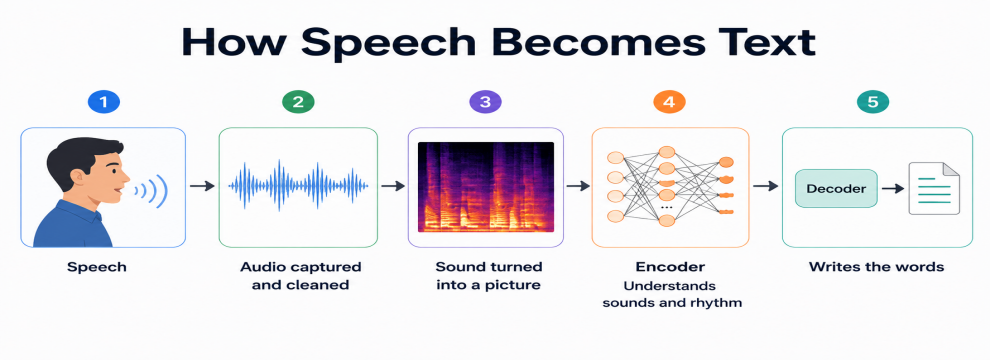
Older systems chained many hand-tuned parts, each adding its own mistakes. Modern systems use one neural network trained end to end on huge amounts of speech, which explains the recent jump in quality.
Most models today follow one of three designs. An encoder-decoder model listens to a chunk of audio, then writes the text. A transducer writes while audio is still flowing in, making it small and fast. A speech-language model connects a speech encoder to a large language model (LLM), which brings strong grammar and context and can even follow text instructions. This third design is where the field is heading.
Key Factors for Accurate Speech Recognition
The same model can give two people very different results. Audio quality matters most: a clear microphone in a quiet room beats a crowded street. Accents and dialects come next, since models that have heard many speakers cope better. Vocabulary matters too, because names and technical terms are missed if the model has not seen them.
Training data and language coverage shape everything. A model excellent in English may be weak elsewhere, which matters in India, where people mix languages in one sentence. Finally, model design and size balance accuracy, speed, and cost. Bigger is often more accurate, but small models can be remarkably fast.
Comparison of Popular ASR Models
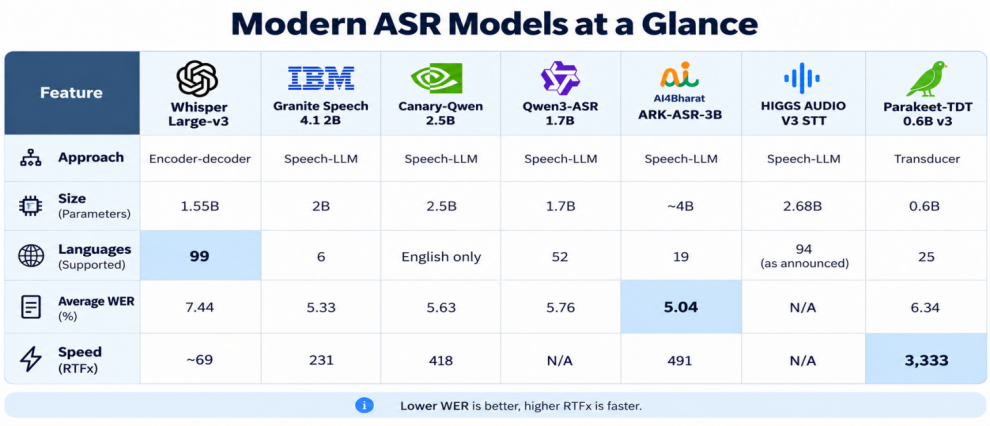
We picked one strong open model from each major family. Two terms help: WER (Word Error Rate) is the share of wrong words, so lower is better. RTFx is how many times faster than real time a model runs, so higher is faster. Figures come from the Hugging Face Open ASR Leaderboard and model cards (2026).
| Feature | Whisper v3 | Granite 4.1 2B |
Canary-Qwen 2.5B |
Qwen3-ASR 1.7B |
ARK-ASR 3B |
HIGGS V3 STT |
Parakeet 0.6B v3 |
|---|---|---|---|---|---|---|---|
| Approach | Encoder-decoder | Speech-LLM | Speech-LLM | Speech-LLM | Speech-LLM | Speech-LLM | Transducer |
| Size | 1.55B | 2B | 2.5B | 1.7B | ~4B | 2.68B | 0.6B |
| Languages | 99 | 6 | English only | 52 | 19 | 94 (claimed) | 25 European |
| Training data | ~5M hours | ~174K hours | Not detailed | Not detailed | Not detailed | Not detailed | 670K+ hours |
| Licence | MIT | Apache 2.0 | CC-BY-4.0 | Check card | Apache 2.0 | Varies | CC-BY-4.0 |
| Avg WER | 7.44 | 5.33 | 5.63 | 5.76 | 5.04 | N/A | 6.34 |
| RTFx | ~69 | ~231 | ~418 | N/A | ~491 | N/A | ~3,333 |
| Live use | Chunked only | Not documented | Not native | Streaming | Not documented | Verify | Streaming |
| Standout | Translation, language detection | Keyword biasing | Summarises transcripts | Timestamps, dialects | Lowest error | Thinking mode | Fastest, smallest |
| Limit | May hallucinate in silence | Few languages | English only | Mostly English and Chinese tests | Owner-reported | Little independent evidence | No Indian languages |
| Best for | Multilingual, subtitles | English with special terms | English plus text analysis | Multilingual with timestamps | Fast English | Trials | High-volume audio |
Whisper v3
Approach
Encoder-decoder
Size
1.55B
Languages
99
Training data
~5M hours
Licence
MIT
Avg WER
7.44
RTFx
~69
Live use
Chunked only
Standout
Translation, language detection
Limit
May hallucinate in silence
Best for
Multilingual, subtitles
Granite 4.1 2B
Approach
Speech-LLM
Size
2B
Languages
6
Training data
~174K hours
Licence
Apache 2.0
Avg WER
5.33
RTFx
~231
Live use
Not documented
Standout
Keyword biasing
Limit
Few languages
Best for
English with special terms
Canary-Qwen 2.5B
Approach
Speech-LLM
Size
2.5B
Languages
English only
Training data
Not detailed
Licence
CC-BY-4.0
Avg WER
5.63
RTFx
~418
Live use
Not native
Standout
Summarises transcripts
Limit
English only
Best for
English plus text analysis
Qwen3-ASR 1.7B
Approach
Speech-LLM
Size
1.7B
Languages
52
Training data
Not detailed
Licence
Check card
Avg WER
5.76
RTFx
N/A
Live use
Streaming
Standout
Timestamps, dialects
Limit
Mostly English and Chinese tests
Best for
Multilingual with timestamps
ARK-ASR 3B
Approach
Speech-LLM
Size
~4B
Languages
19
Training data
Not detailed
Licence
Apache 2.0
Avg WER
5.04
RTFx
~491
Live use
Not documented
Standout
Lowest error
Limit
Owner-reported
Best for
Fast English
HIGGS V3 STT
Approach
Speech-LLM
Size
2.68B
Languages
94 (claimed)
Training data
Not detailed
Licence
Varies
Avg WER
N/A
RTFx
N/A
Live use
Verify
Standout
Thinking mode
Limit
Little independent evidence
Best for
Trials
Parakeet 0.6B v3
Approach
Transducer
Size
0.6B
Languages
25 European
Training data
670K+ hours
Licence
CC-BY-4.0
Avg WER
6.34
RTFx
~3,333
Live use
Streaming
Standout
Fastest, smallest
Limit
No Indian languages
Best for
High-volume audio
For language coverage, look at Whisper, HIGGS, and Qwen3-ASR. For top English accuracy, ARK-ASR, Granite, Canary-Qwen, and Qwen3-ASR sit close together. For raw speed, choose Parakeet. Leaderboards mostly test short English audio, so treat these numbers as a clue, not a verdict.
Challenges and Practical Considerations
Even the best models are not perfect. Noise, overlapping speakers, and poor microphones still cause errors, and code-mixing, such as switching between English and a regional language mid-sentence, remains hard. Rare names and technical terms are often misspelt. Some models hallucinate words during silence, so trim silent parts first. Speech also carries personal data, so consider privacy and licensing. The safest approach: shortlist two or three models and test them on your own audio sample.
Applications and Future of ASR
ASR already powers voice assistants, dictation, captions, and call-centre analytics, supports doctors, lawyers, and journalists, and improves accessibility. Ahead, speech and language models are merging, so one system can transcribe, translate, summarise, and answer questions about audio. Smarter training helps small models match large ones, and on-device transcription is becoming practical. The biggest gap remains regional and low-resource languages, including many Indian languages, where much of the next progress is expected.
Conclusion
ASR has moved from hand-built parts to single models, and now to speech-language models that pair an audio encoder with an LLM. Whisper remains the broad, mature multilingual choice, newer models show how LLM decoders improve accuracy, and Parakeet proves a small transducer can be extremely fast.
There is no single best model for everyone. The right choice depends on your languages, your audio, and whether you value accuracy, speed, or flexibility. Leaderboards are a good starting point, but the most reliable test is always your own audio.
Frequently Asked Questions
An ASR system processes captured audio, converts it into a spectrogram, extracts speech patterns through an encoder, and then generates text using a decoder, transducer, or language model.
The three major ASR architectures are encoder-decoder models, transducer models, and speech-language models. Encoder-decoder models process audio before generating text, transducers can generate text while audio is still being processed, and speech-language models connect a speech encoder with a large language model.
WER, or Word Error Rate, measures the number of word-level errors in an ASR transcript. A lower WER generally indicates better transcription accuracy.
RTFx measures how many times faster than real time an ASR model can process audio. A higher RTFx indicates faster processing and can be useful when comparing models for high-volume transcription.
The right ASR model depends on factors such as language coverage, transcription accuracy, audio conditions, processing speed, streaming requirements, hardware, and deployment needs. Testing shortlisted models on your own audio is the most reliable way to evaluate them.