
Drilling NPT Prevention Agent:
Stop Losing Days to Surprises
⏱ 10 min read | 🤖 AI & Automation | 🎯 For Decision Makers & Leaders
Introduction: Drilling NPT Prevention Agent
Drilling NPT Prevention Agent (NPT) remains one of the most persistent and expensive challenges in drilling operations. Despite experienced crews, advanced rigs and standardized reporting, unexpected events still cost operators days of lost time per well.
At Logassa Inc, we design Drilling NPT Prevention Agent that continuously monitor real-time drilling signals, analyze Daily Drilling Reports (DDRs), retrieve lessons from offset wells and generate action-ready, evidence-backed alerts-while ensuring all operational decisions remain fully human.
The Problem: Why Drilling Teams Still Lose Time
Drilling NPT Prevention Agent (NPT) refers to any time spent on drilling activities that do not advance the well. Common causes include:
- Equipment dysfunction
- Wellbore instability (e.g., stuck pipe)
- Waiting on decisions
- Operational rework
Most rigs already capture NPT categories using IADC DDR Codes and real-time data is streamed through standards such as WITSML.
Yet incidents still escalate.
Why NPT Happens - Even With Experienced Teams: Drilling NPT Prevention Agent
NPT is rarely caused by negligence. It emerges from human limits under complex conditions:
- High-volume real-time signals are easy to miss during busy shifts
- Context is fragmented across sensors, DDR narratives and historical wells
- Shift handovers lose the “story” behind subtle trend changes
- Teams react after thresholds are crossed instead of earlier trend shifts
💡Bottom line:
The rig already produces enough data to prevent many issues. The challenge is converting that data into fast, consistent, evidence-based decisions.
What “Early Warning” Actually Means in Drilling: Drilling NPT Prevention Agent
True early warning is not another alarm.
It means:
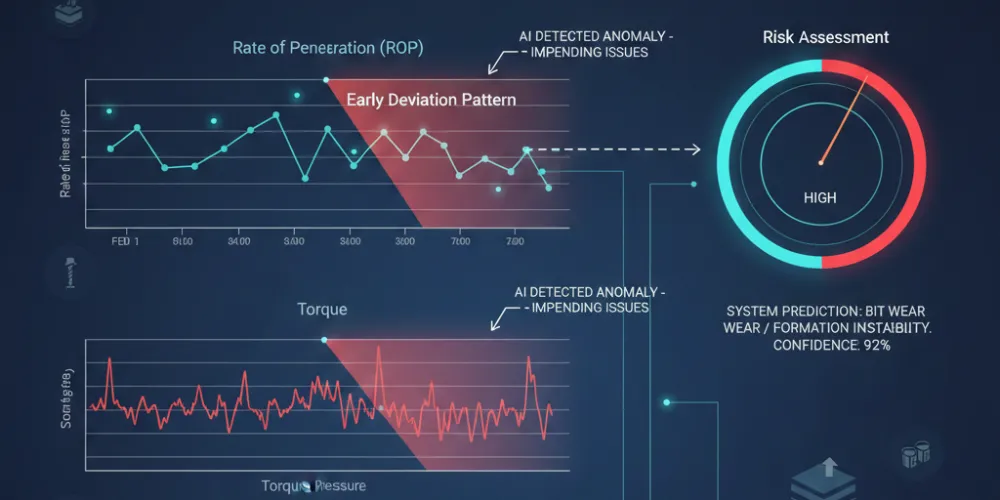
- Detecting trend deviations, not just threshold breaches
- Explaining “why this matters now” in plain language
- Attaching verifiable evidence (signals, time windows, notes)
- Suggesting mitigations aligned to approved practices
If there is no evidence, there should be no alert.
The Manual Reality Today (and Why It’s Costly)
Most Drilling NPT Prevention Agent teams rely on dashboards, shift calls and expert judgment. This approach works but no scale.
What Teams Do Manually?
- Monitor multiple real-time dashboards
- Write and interpret DDR narratives
- Search offset wells for similar symptoms
- Coordinate calls between rig, engineers and RTOC
- Decide under pressure, document later
Why this Consumes Time & Resources?
- Constant context switching between tools
- Tribal knowledge locked in experts or PDFs
- Slow retrieval of similar cases during incidents
- Inconsistent decisions across shifts
- Weak feedback loops into future planning
💡Result:
Late escalation, repeated issues across wells and growing coordination overhead-especially in remote monitoring environments.
The Solution: Drilling NPT Prevention Agent
A Drilling NPT Prevention Agent acts as an always-on co-pilot.
It does not control equipment.
It does not replace engineers.
It supports faster, more consistent decision-making.
How Agentic AI + GenAI Solve the Problem
Detect
Evidence
Retrieve
Explain
Suggest
Escalate
Full audit trail included.
What Makes This “Agentic” (Not a Chatbot)
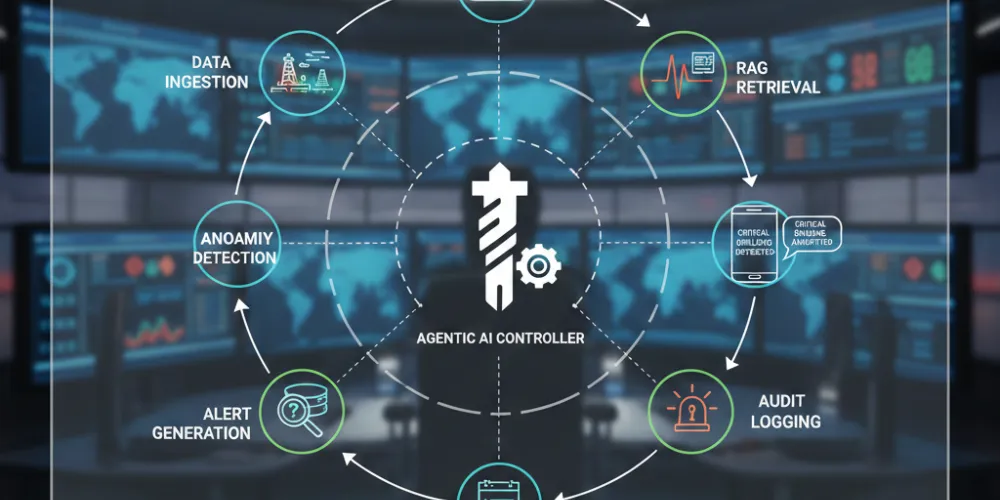
The agent executes a multi-step workflow:
Detect → Retrieve → Explain → Suggest → Escalate → Log
This is orchestration across systems-not conversational guessing.
Real-World Deployment Flow
Ingest live Drilling NPT Prevention Agent parameters, DDR notes and offset well documents
Detect early risk patterns and assign confidence
Retrieve similar cases and proven mitigations
Generate evidence-backed alerts with “why now”
Human review → decision → outcome logged
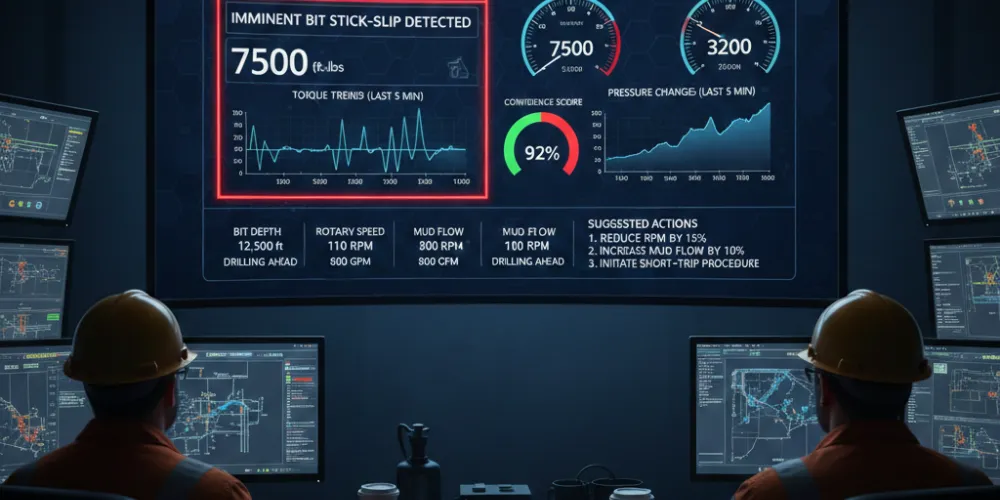
What a High-Quality Alert Includes?
Risk type: e.g., developing stuck pipe
Evidence: torque trend, pressure change, ROP drop
Context: hole section, BHA, mud properties
Suggested actions: aligned to approved runbooks
Escalation: Drilling NPT Prevention Agent engineer, superintendent if risk increases
Reference Architecture (High Level)
Data & Integration Layer
- WITSML ingestion and normalization
- Time-series stores (rig sensors, mud logging, MWD/LWD)
- Document repositories (DDRs, post-well reports)
- Well master data (rig, section, BHA metadata)
AI & Orchestration Layer
- Anomaly detection and risk classification
- RAG grounded in approved documents
- Agent orchestration with guardrails
- Confidence scoring, explainability, audit logs
Pilot Scorecard: How Success Is Measured
Operational Metrics
- Time-to-detect
- Time-to-decision
- Engineer-validated NPT hours avoided
- Reduction in repeated issues
Quality Metrics
- Engineer usefulness rating per alert
- % alerts with evidence and explanation
- False alarm rate
- Recall on known precursor patterns
Safety & Governance Guardrails (Non-Negotiable)
Human-in-the-loop approvals
Role-based access control (RBAC)
“No evidence → no claim” policy
End-to-end audit logging
Why Does This Improves Safety?
Earlier awareness reduces emergency conditions
Consistency across shifts improves handovers
Evidence-backed alerts reduce decision pressure
Stronger learning loops improve future wells
Final Thought: Drilling NPT Prevention Agent
Drilling NPT Prevention Agent are not about automating drilling decisions.
They are about supporting the people who make them-earlier, more consistently and with better evidence.
At Logassa Inc, we build agentic AI systems that respect operational authority while delivering measurable reductions in downtime, risk and uncertainty.
👉 The best time to start was yesterday. The second-best time is today-with Logassa Inc and our advanced AI solutions.
Know more about our works with our Blogs. Happy Reading!