
How to Set Up a GCC in India:
Complete Guide for Companies
🕑 8 min read | 📂 GCaaS | 🎯 For CTOs, Leaders, L&D Heads
How to set up a GCC in India is becoming a strategic question for foreign companies looking beyond traditional outsourcing. India has moved well beyond the old back-office model. Its Global Capability Centres now support product engineering, artificial intelligence, cybersecurity, finance, analytics, research and development, data engineering and other high-value global functions.
Why Are Foreign Companies Setting Up GCCs in India?
India combines a large technology workforce, established IT infrastructure, mature business ecosystems and specialised talent across engineering, finance, analytics and emerging technologies.
Access to a Large Technology Talent Pool
India has a deep workforce across software engineering, cloud, data, AI, cybersecurity, finance and other specialised disciplines that seamlessly help companies meet their goals.
Strong Technology Ecosystem
India already has mature ecosystems around software development, cloud computing, enterprise technology, data platforms and AI.
3. Growing AI and R&D Capabilities
The Indian GCC model is increasingly moving toward AI, product development, engineering and innovation to cater customised needs and requirements for growth.
Operating Cost Advantage
A more sustainable approach is to compare the total value created per employee rather than simply comparing salary costs between countries.
The Current GCC Landscape in India
How Many GCCs Are in India?
2100+
GCC Centers
2117
Active GCCs
1950
Expanded Last Quarter
2.36M
People Employed
Where Should You Set Up a GCC in India?
Location selection is one of the most important decisions in the entire process.
There is no universally "best" GCC city. The right choice depends on talent requirements, business function, operating cost, customer proximity, infrastructure and long-term expansion plans.
Tier-II Cities
The next stage of GCC expansion is not limited to India's traditional technology hubs.
Cities including Ahmedabad, Jaipur, Kochi, Coimbatore, Mysuru, Nashik and Nagpur are increasingly being considered as part of multi-city GCC strategies.
JLL reports that Tier-II markets can offer approximately 10–35% cost savings while providing access to additional talent pools.
How to Set Up a GCC in India: Step-by-Step Process
Setting up a GCC should be treated as a business transformation project rather than a simple incorporation exercise.
Step 1: Define the GCC's Strategic Purpose
Before selecting a city or hiring anyone, define what the centre is expected to own.
Ask:
– What functions will move to India?
– Will the GCC provide support or own complete processes?
– Will it perform R&D?
– Will it develop products?
– Will it manage AI and data initiatives?
– How many employees are expected in three years?
– What KPIs will determine success?
A GCC built only around headcount can quickly become another cost centre.
A GCC built around capability ownership has a much stronger long-term case.
Step 2: Select the Operating Model
A foreign company can evaluate different structures depending on its activities, regulatory requirements and commercial objectives.
Common options may include:
Wholly Owned Subsidiary
A foreign parent establishes an Indian company that operates as its subsidiary.
This can provide greater control and is commonly considered for long-term GCC operations.
Branch Office
A branch can be appropriate for certain permitted activities, subject to applicable RBI/FEMA requirements.
RBI regulations provide for specified activities for branch offices, including IT and software development services and certain research-related activities.
Liaison Office
A liaison office has a much narrower role and generally functions as a communication and representation channel rather than a full operating GCC.
The appropriate structure depends heavily on the foreign company's industry, functions, revenue model and intended activities. Legal and tax advisors should therefore be involved before incorporation.
Step 3: Evaluate FDI and Regulatory Requirements
Foreign investment into India is governed by the country's FDI framework.
India generally permits up to 100% FDI through the automatic route in many sectors, subject to applicable sectoral rules, laws and conditions.
However, companies should not assume that every GCC activity automatically receives identical treatment.
The setup team should evaluate:
– FDI eligibility
– Sector-specific conditions
– FEMA requirements
– RBI reporting
– Corporate registrations
– Tax registrations
– GST implications
– Employment requirements
– Data protection obligations
– Industry-specific regulations
This is one area where professional legal and tax advice is not optional.
Step 4: Choose the Right City and Office Strategy
The office decision should follow the talent strategy, not the other way around.
Consider:
– Availability of specialised talent
– Salary levels
– Employee retention
– Airport connectivity
– Office infrastructure
– Data centre and cloud ecosystem
– Existing vendor ecosystem
– Business continuity
– Government incentives
– Future expansion capacity
A multi-city model can also reduce concentration risk and improve business continuity.
Step 5: Build the Technology Foundation
A technology-heavy GCC needs a proper architecture from the beginning.
This can include:
– Cloud infrastructure
– Cybersecurity
– Identity and access management
– Collaboration tools
– DevOps
For an AI-led GCC, the technology roadmap should also define how AI will be developed, deployed, monitored and governed.
This is where capabilities such as OCR, document intelligence, computer vision, generative AI, data engineering and workflow automation can become practical components of the GCC rather than isolated technology experiments.
Step 6: Build the Talent Strategy
Hiring 50 people is not the same as building a GCC.
Talent strategy should also consider succession planning, employee retention and internal career progression.
The current market is already showing a growing demand for specialised AI and engineering skills. Recent industry reporting has highlighted talent shortages as one of the biggest constraints on India's next phase of GCC expansion.
Step 7: Establish Governance and Compliance
A GCC handles sensitive company information, intellectual property and potentially customer data. The exact requirements depend on the GCC's activities and parent-company jurisdiction.
Step 8: Start Small, Then Scale
A foreign company does not necessarily need to launch a 500-person GCC on day one.
A phased model is often more practical:
Phase 1: Strategy and setup
Phase 2: Core team and pilot functions
Phase 3: Process expansion
Phase 4: Technology and R&D ownership
Phase 5: Global capability leadership
This makes it easier to test the operating model before making major long-term commitments.
How Much Does It Cost to Set Up a GCC in India?
There is no reliable single answer to the question of GCC setup cost.
Anyone giving a universal number without understanding the company's requirements is oversimplifying the problem.
The total investment depends on:
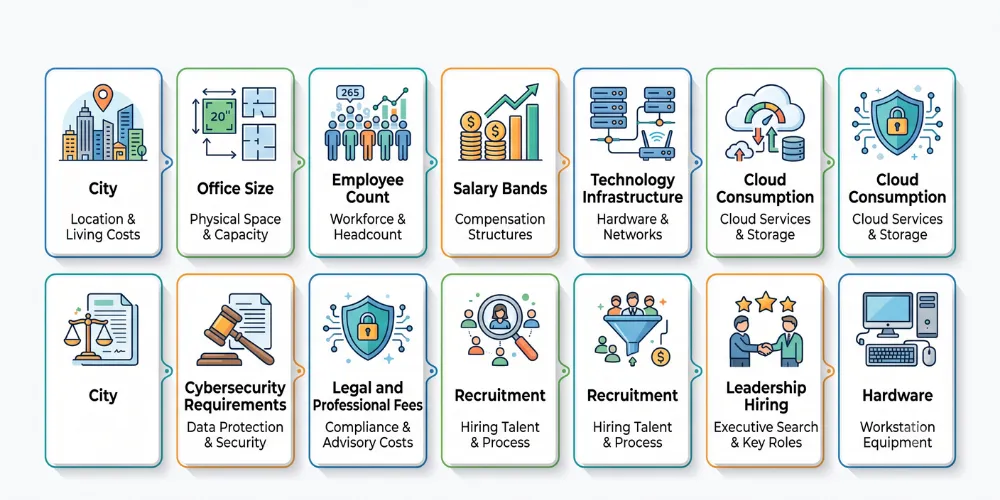
A 50-person AI engineering centre and a 500-person global finance GCC will have completely different cost structures.
For this reason, foreign companies should build a three-to-five-year GCC business case, rather than evaluating the project solely on first-year operating costs.
Upcoming GCC in India: What Foreign Companies Should Watch
The next wave of GCC expansion is likely to be shaped by four factors:
AI and Advanced Engineering
AI, machine learning, data engineering, robotics and advanced software engineering are likely to remain major capability areas.
Industry-Specific GCCs
Instead of generic technology centres, companies are building specialised hubs around healthcare, BFSI, automotive, manufacturing, semiconductors and life sciences.
State-Level Incentives
Indian states are increasingly competing to attract GCC investment. For example, Maharashtra's 2025 GCC policy aims to attract around 400 new GCCs
Distributed GCC Models
Companies may increasingly combine a primary metro location with secondary cities to balance talent, cost and resilience.
Why Logassa LLC for GCC-as-a-Service?
Logassa LLC is a Pune-based AI solutions company focused on building customized AI and data solutions for global enterprises. Its capabilities span Generative AI, Agentic AI, computer vision, data engineering, Speech AI, intelligent automation and other enterprise AI applications.
For a foreign company entering India, this means the GCC does not have to start with a blank technology roadmap. A specialised AI partner can help identify automation opportunities, build initial AI capabilities, integrate them into enterprise workflows and gradually transfer ownership to the GCC team.
GCC in India: Way Ahead
India can give your company the talent, technology and scale to build a truly global capability centre.
At Logassa LLC, we help foreign companies turn their India GCC vision into technology-driven capabilities through AI, Data Engineering, Automation, Computer Vision, OCR and Generative AI solutions

Planning a GCC in India? Let’s talk.
Niraj P Lunavat
Founder & CEO, Logassa LLC
Contact →
Discuss your GCC, AI or technology requirements with our team.