
Smart Permits: How AI Agents for Work Permit
Streamline & Analyse Job Safety
⏱ 9 min read | 🤖 Agentic AI | 🎯 For Decision Makers
The Challenge: Safety Systems Struggling to Keep Pace
Agents for Work Permit (PTW) and Job Safety Analysis (JSA) are now a foundational safety control. However, modern industrial operations now involve more contractors, more simultaneous activities and tighter execution windows than traditional permit workflows were designed to handle.
High-stakes environments
In industries such as oil & gas, chemicals, power and manufacturing, a small planning gap can escalate into a serious incident. Therefore, agents for work permit systems must ensure traceability, consistency and accountability at every step.
SIMOPS complexity
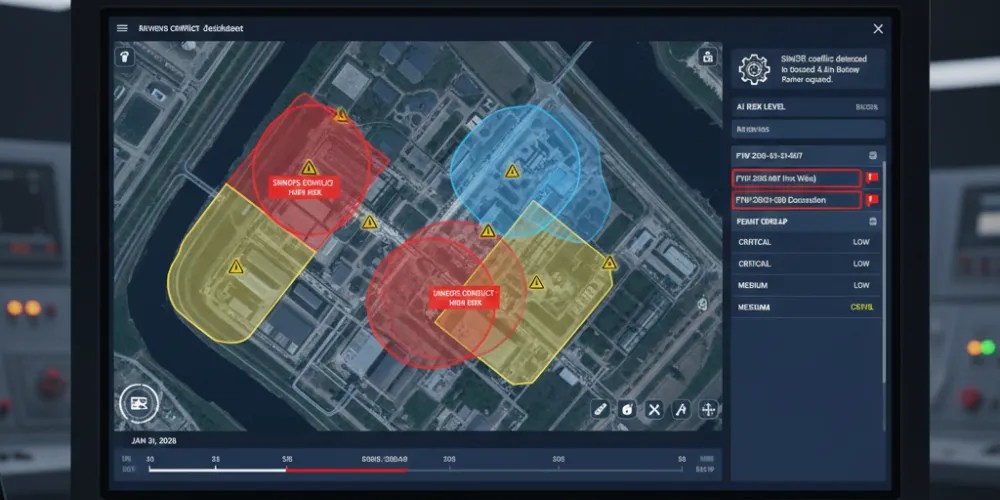
Simultaneous Operations (SIMOPS) introduce overlapping risks across units, locations and scopes for agents for work Permit. Manually identifying spatial and temporal conflicts across dozens of permits quickly becomes a cognitive overload.
Workforce pressure
Night shifts, contractor turnover and schedule pressure increase the likelihood of rushed permits and inconsistent JSAs-even among experienced supervisors.
Why Traditional PTW & JSA Processes Fall Short: Agents for Work Permit
Most safety failures are not caused by negligence. Instead, they stem from human limits, fragmented systems and workflows that do not scale with operational reality.
Operational friction
Permit cycles often become slow, form-heavy and repetitive. Under pressure, teams may unintentionally trade depth of hazard analysis for speed.
Inconsistent hazard identification
Two supervisors performing identical work on these agents for work permit produce very different JSAs. Meanwhile, copy-paste templates frequently miss site-specific hazards.
Conflict checking doesn’t scale
Manually validating conflicts across multiple permits, locations and time windows is extremely difficult to do reliably and quickly.
Weak learning loops
Near-misses and incident learnings often remain locked in PDFs or databases, rarely feeding back into everyday permit quality.
Where AI Fits-and Where It Does Not
AI agents for work permit in PTW and JSA systems should reduce friction and improve consistency, while keeping authority, accountability and approvals firmly human.
What an AI agent can do? ✅
- Draft PTWs and JSAs from plain-language job descriptions
- Retrieve relevant SOPs, standards and learnings using RAG
- Flag missing fields, prerequisites and overlooked hazards
- Detect SIMOPS conflicts and escalation conditions
- Route approvals and maintain a complete audit trail
What an AI agent must never do? ❌
- Autonomously approve permits or bypass sign-offs
- Act as a black box without sources or traceability
- Recommend controls without citing approved procedures
- Trigger equipment actions without explicit human governance
In short: AI assists; humans decide.
How a PTW/JSA AI Agents for Work Permit is Executed in the Real World
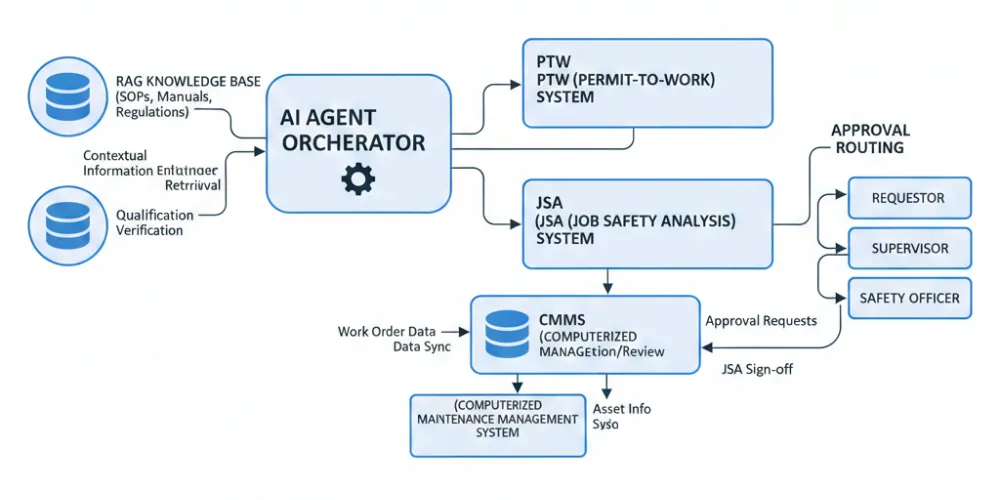
Serious deployments follow a predictable, auditable architecture: retrieve approved knowledge, validate prerequisites and route approvals-with every step logged.
Draft
The worker describes the task in natural language. The agent extracts key entities such as equipment, location and work type, then pre-fills PTW and JSA drafts using site-approved templates for our agents for work Permit.
Retrieve & Cite
Using Retrieval-Augmented Generation (RAG), the agent pulls relevant SOPs, isolation procedures and historical learnings that match the exact context. Every recommendation is source-backed.
Validate & Route
The agent checks prerequisites through integrated systems such as training records, gas test logs and CMMS. It then routes the permit through defined approval workflows while maintaining a full audit trail.
What Makes This “Agentic”-Not Just a Chatbot
This is not conversational automation. It is orchestration.
The agent executes a multi-step workflow across systems:
Draft → Retrieve → Validate → Conflict-check → Route → Log
Each step is deliberate, traceable and governed.
Typical integrations
- PTW systems for permit authoring and approvals
- CMMS platforms (SAP, IBM Maximo) for asset and work order context
- Training and competency systems for authorization checks
- Gas testing and fire-watch logs
- Document management systems for SOPs and standards
Implementation Roadmap: From Trust to Scale - Agents for Work Permit
Successful rollouts prioritize trust and auditability first, then expand capability.
1) Assess (2–4 weeks)
Map current PTW/JSA workflows, identify bottlenecks and inventory data sources and integrations.
2) Pilot (8–12 weeks)
Start with one site or permit type. Run the agent in shadow mode before enabling assistive drafting. Measure:
- Cycle time
- Rework frequency
- Hazard completeness
- User adoption
3) Govern
Enforce role-based access, citations, approval gates and audit logs. If the agent cannot find an approved source, it does not answer.
4) Scale
Expand facility by facility using a risk-based approach. Add advanced validation and conflict detection as confidence grows.
Limitations to Acknowledge: Agents for Work Permit
Credible safety systems earn trust by being explicit about limitations.
Data quality is critical
Outdated SOPs or incomplete incident data will degrade outputs. Strong governance is essential.
Over-trust is a risk
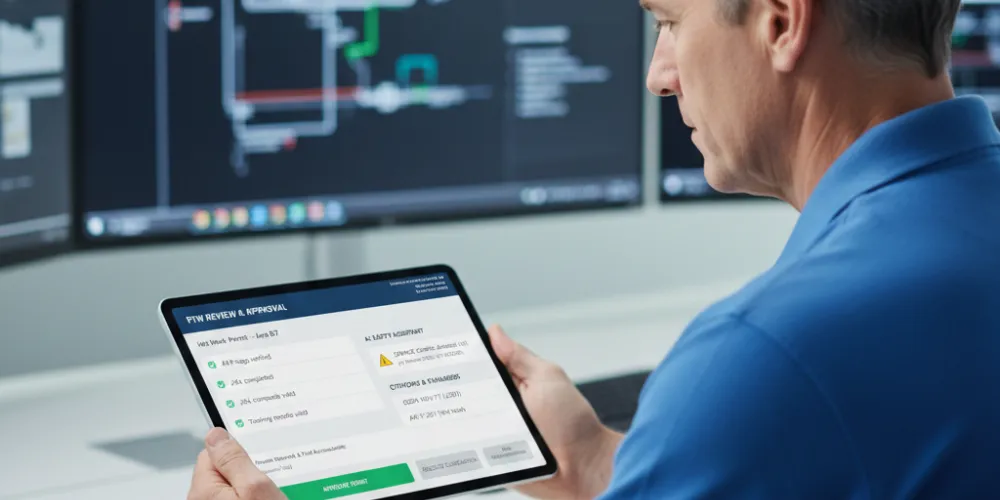
Interfaces must encourage review and verification-never blind acceptance.
Integration takes planning
Legacy systems vary widely. Start small, then scale deliberately.
Final Thought: Agents for Work Permit
PTW and JSA AI agents for work permit are not about automating safety decisions.
They are about supporting the people who make them-improving consistency, reducing friction and making safety planning easier to audit at scale. When designed correctly, AI does not weaken safety culture. It reinforces it.
👉 The best time to start was yesterday. The second-best time is today-with Logassa Inc and our advanced AI solutions.
Know more about our works with our Blogs. Happy Reading!