Healthcare

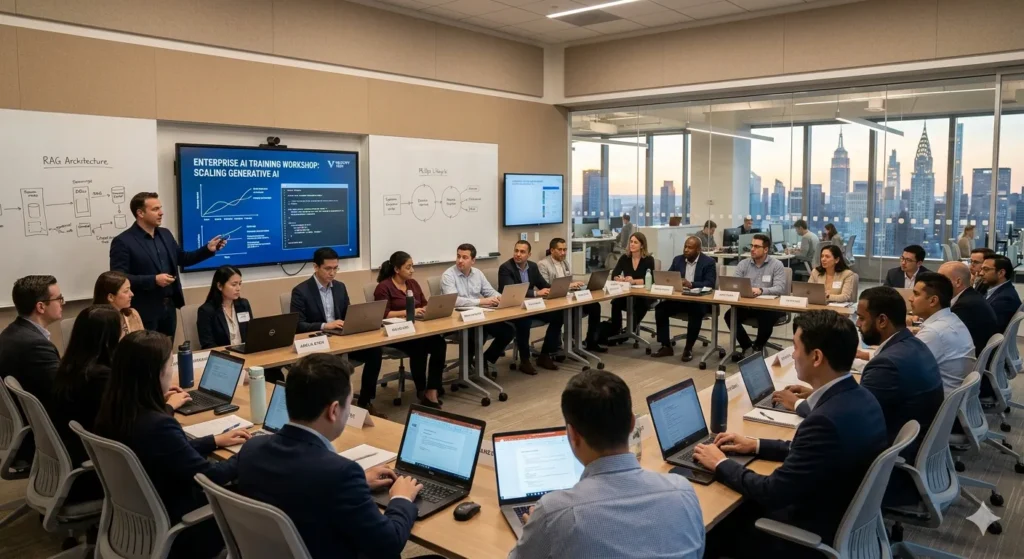
AI Training for Companies workshop for US enterprise teams

AI Training for Companies USA

AI Training for Companies USA: Driving Enterprise Growth 🕑 6 min read | 📂 Enterprise AI | 🎯 For CTOs, HR Leaders, L&D Heads AI Training for Companies is no longer optional for US enterprises aiming to stay competitive. Artificial Intelligence has moved from experimentation to execution. However, most organizations still struggle with one critical gap – workforce readiness. At Logassa LLC, Austin, Texas, we help enterprises transform AI investments into measurable ROI through structured, compliance-ready AI training programs built for scale. The Enterprise Problem: AI Tools Exist, ROI Does Not Across the United States, companies are investing heavily in AI platforms for automation, analytics, marketing & engagement. Yet many fail to unlock full value. Common enterprise challenges include: – Employees unsure which AI tools to use – Misconception that AI is too technical – Fear of job displacement – Lack of structured governance – No measurable ROI framework Without proper AI Training for Companies, AI adoption becomes fragmented and underutilized. Practical AI Implementation Across Departments AI Training for Companies Across Enterprise Teams AI adoption must extend beyond IT. Logassa trains: – Marketing & HR Teams (AI-Driven Campaigns & Analytics) – Finance & Sales Teams (Predictive Insights, AI-Powered CRM & Automation) – Operations Leaders (Process Automation & Efficiency) – Executive Management (AI Strategy & Governance) Every session focuses on practical execution within real job functions. Eliminating the Fear: AI Enhances Human Performance One question dominates enterprise conversations: “Will AI replace jobs?” Through structured AI Training for Companies, teams quickly understand a critical truth: AI enhances performance. It does not replace expertise. Employees learn to: – Automate repetitive workflows – Improve data-driven decisions – Reduce manual processing time – Focus on strategic initiatives By the end of training, hesitation transforms into an innovative mindset. Measurable ROI from AI Training for Companies Organizations that implement structured AI Training for Companies experience measurable gains: ✔ Faster task execution & Reduced operational costs ✔ Improved research accuracy & Higher content quality ✔ Stronger cross-team collaboration ✔ Increased automation adoption Many enterprises report saving multiple hours per employee per week. At scale, this translates into significant operational ROI. Built for Enterprise Compliance & Scalability In the US market, compliance is non-negotiable. Logassa ensures that AI Training for Companies program aligns: HIPAA (Healthcare AI usage) SOC 2 (Security & governance controls) Data privacy best practices Responsible AI frameworks Logassa’s AI Training for Companies programs are designed for: Multi-location enterprises Hybrid and remote teams Enterprise-grade security environments Localite training for best availability AI adoption without compliance creates risk. AI training with governance creates competitive advantage. Why Do US Enterprises Choose Logassa? Companies partner with Logassa because we focus on: – Performance-driven AI integration with enterprise-grade security standards – Scalable workforce transformation – Automation-first thinking & ROI frameworks We do not just train teams on tools. We help enterprises build AI-ready cultures. The Future of Enterprise Growth Is AI-Enabled Artificial Intelligence is redefining business operations across the United States. However, competitive advantage does not come from owning AI platforms. It comes from empowering teams to use them effectively. AI Training for Companies bridges the gap between technology investment and business transformation. Ready to Scale with AI? 📈 If your organization is preparing for enterprise AI adoption, compliance alignment and measurable ROI, Logassa can help. Empower your workforce. Strengthen governance. Accelerate automation.

AI Training for Companies USA Read More »
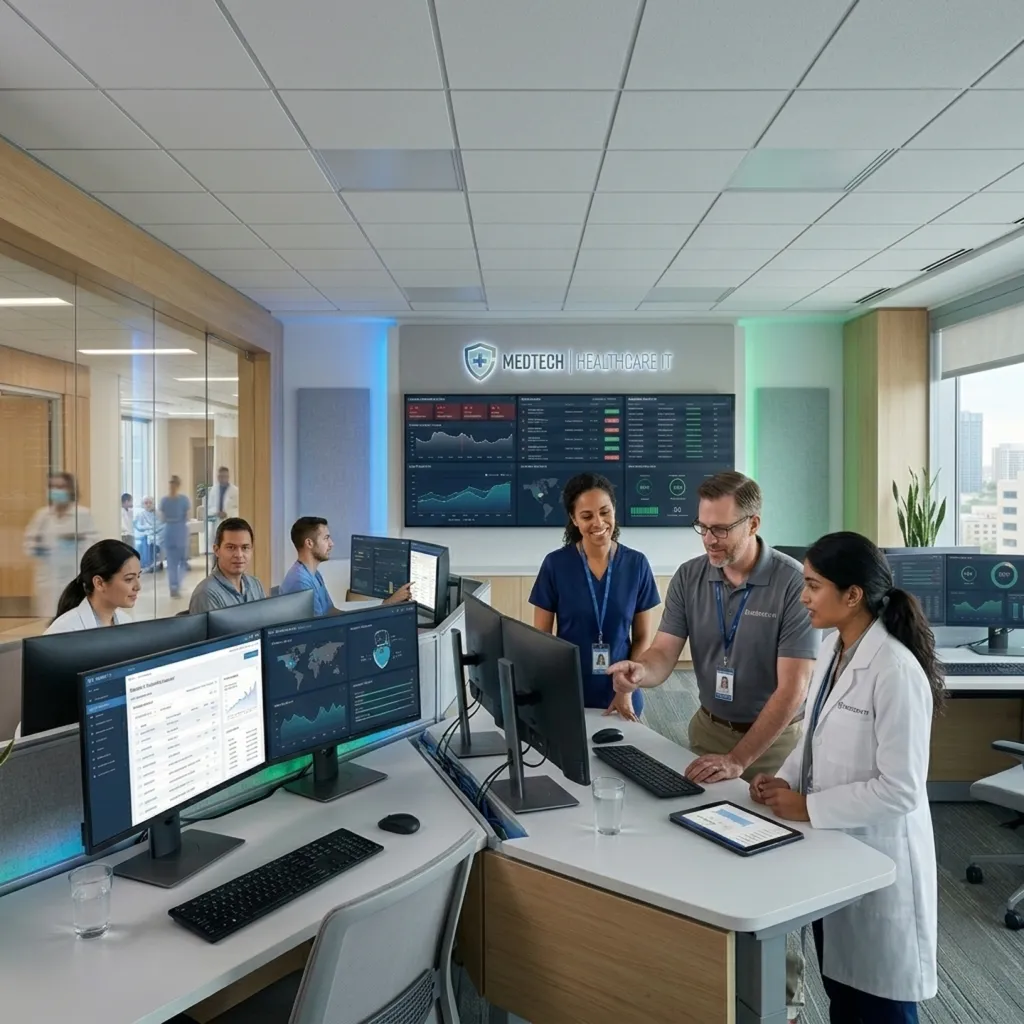
Clinical-grade RAG architecture for healthcare decision support

Clinical-Grade RAG Architecture for Healthcare

Architecting Trust: Why Clinical-Grade RAG Architecture Fails in Clinical Environments? ⏱ 8–9 min read | 🏥 Healthcare AI & Clinical Innovation | 🎯 For Healthcare Leaders, Clinical Decision Makers & Professionals Executive Summary: Clinical-Grade RAG Architecture Clinical-Grade RAG Architecture or Generic “vector DB + LLM” Retrieval-Augmented Generation (RAG) patterns are not clinically trustworthy because they optimize for plausible language – not verifiable medical evidence. In healthcare environments, architecture must enforce: – Medical Entity Linking (UMLS-aware normalization) – Attribution-first generation with zero-tolerance hallucination policy (AQA) – Privacy-preserving, PHI-scoped retrieval – Temporal reasoning and time-weighted ranking The objective is not automation of diagnosis. The objective is Clinical Decision Support (CDS) for Clinical-Grade RAG Architecture that is evidence-grounded and auditable. The Clinical Challenge: Clinical-Grade RAG Architecture Clinical-Grade RAG Architecture documentation is heterogeneous and longitudinal. A single patient record may include: – Structured billing codes (ICD-10, CPT) – Problem lists – Radiology narratives – Discharge summaries – Medication reconciliations – Scanned PDFs Even within one EHR, semantic consistency is not guaranteed. Generic RAG fails due to: – Synonymy: “myocardial infarction” vs “heart attack” – Abbreviation overload: “MS” (multiple sclerosis vs morphine sulfate) – Negation complexity: “no evidence of pneumonia” – Temporal drift: 2018 medication list vs 2024 reconciliation In a consumer chatbot, hallucination is inconvenient. In healthcare, it is a patient safety risk. Therefore, Clinical-Grade RAG Architecture must be engineered as a CDS capability – supporting clinicians with evidence while preserving licensed medical accountability. Figure 1. Clinical-grade RAG pipeline: MEL → temporal retrieval → attribution → verification → HITL Technical Architecture (Risk-Averse by Design) This architecture is intentionally conservative. It is designed to support clinicians – not replace them Pillar A Medical Entity Linking (MEL) with Unified Medical Language System (UMLS) Problem: Standard embeddings underperform in biomedical synonymy and abbreviation ambiguity. Clinical-Grade Approach – Extract problems, medications, labs – Map mentions to UMLS CUIs – Preserve original surface forms for auditability Query normalization enables: – Expansion (“heart attack” → myocardial infarction, MI) – Constraint preservation (negation, temporality) Result: Retrieval precision improves without sacrificing traceability. The system remains CDS. Clinicians verify the cited source. Pillar B Hallucination Zero-Tolerance via Attributed Question Answering (AQA) Healthcare cannot tolerate plausible guesses. AQA reframes generation as attribution: The model may state a clinical fact only if it can cite a supporting span. Implementation Pattern – Retrieve candidate evidence – Generate answer with explicit citations – Verify claim-level support against spans Target metric: – Increased claim support rate – Controlled reduction in answer rate In medicine, abstention is often safer than over-answering. Pillar C PHI-Aware Retrieval & Localized Vector Stores Clinical text contains Protected Health Information (PHI). Architecture must enforce: – Patient-scoped retrieval Role-Based Access Control (RBAC) – Encrypted-at-rest indices – Tenant isolation – Audit logging For CDS workflows, de-identification is often insufficient. Access controls must be enforced pre-retrieval – not post-generation. Deployment may be on-prem or within private VPC environments aligned with HIPAA compliance standards. The system supports clinical workflows. Interpretation remains the responsibility of a licensed practitioner. Pillar D Temporal Context & Time-Weighted Retrieval Clinical truth evolves over time. Generic similarity search ignores recency. Clinical-grade retrieval introduces: – Timestamp decay functions – Encounter-based bucketing – Query-aware recency weighting Example: – “Current medications” → prioritize latest reconciliation – “History of diabetes” → include longitudinal evidence This ensures safer CDS behavior while preserving historical context. Figure 2. Safety-first pillars for Medical RAG Consumer RAG vs Clinical-Grade RAG Architecture Area Consumer RAG Medical RAG (Clinical-Grade) Security Cloud – First, Broad Indexing Patient – Scoped Retrieval, Private Vector Stores, RBAC, Audit Accuracy Similarity – Only Retrieval UMLS-Backed MEL + Hybrid Retrieval Time Often Ignored Time – Weighted Ranking Attribution Optional Citations Mandatory Claim – Level Verification Hallucination Mitigated Heuristically Zero – Tolerance + Abstention Policy Clinical trustworthiness increases with verification, even if latency & compute cost rise. The Truth-Check Flow: Clinical-Grade RAG Architecture Step 01 Retrieve & Constrain – Validate patient scope – Enforce access rights – Hybrid retrieval (lexical + biomedical embeddings) – Apply temporal weighting Output: Ranked evidence set with metadata. Step 02 Generate with Attribution – Every claim must cite source + timestamp – No diagnostic directives – Evidence presentation only Step 03 Verify & Decide – Claim-level span verification – Unsupported claims removed or downgraded – Route to HITL if ambiguity persists Output: Verified summary + audit bundle (citations, spans, confidence scores) Figure 3. Trust vs latency trade-off in clinical RAG systems Roadmap for HIPAA-Aligned Deployment: Clinical-Grade RAG Architecture Phase 0 Governance – Define CDS scope – Establish escalation pathways – Formalize change control Phase 1 Secure Ingestion – Normalize HL7 / FHIR / C-CDA – Preserve provenance – Attach metadata (patient, encounter, author, timestamp) Phase 2 Clinical-Grade Retrieval – Biomedical embeddings – UMLS-aware MEL – Hybrid + temporal ranking – Cross-encoder reranking for high-risk queries Phase 3 Attribution & Verification – AQA enforcement – Abstention policy – Persistent audit bundle Phase 4 Safety Monitoring – Track faithfulness – Monitor answer rate – Evaluate retrieval sensitivity – Clinical stakeholder review loops Phase 5 Deployment – Prefer on-prem or private VPC – Encryption in transit & at rest – Least-privilege IAM – Vendor risk management Conclusion: Clinical-Grade RAG Architecture Clinical-Grade RAG Architecture systems optimize for fluency. Clinical-Grade RAG Architecture systems optimize for verifiable truth, temporal correctness and patient safety. For CMIOs and healthcare data architects, the decision is architectural – not experimental. Trust in clinical AI is not a feature. It is the outcome of deliberate design. At Logassa, we engineer AI systems where reliability, compliance and auditability are foundational – not optional. 👉 The best time to start was yesterday. The second-best time is today-with Logassa Inc and our advanced AI solutions. Know more about our works with our Blogs. Happy Reading!

Clinical-Grade RAG Architecture for Healthcare Read More »

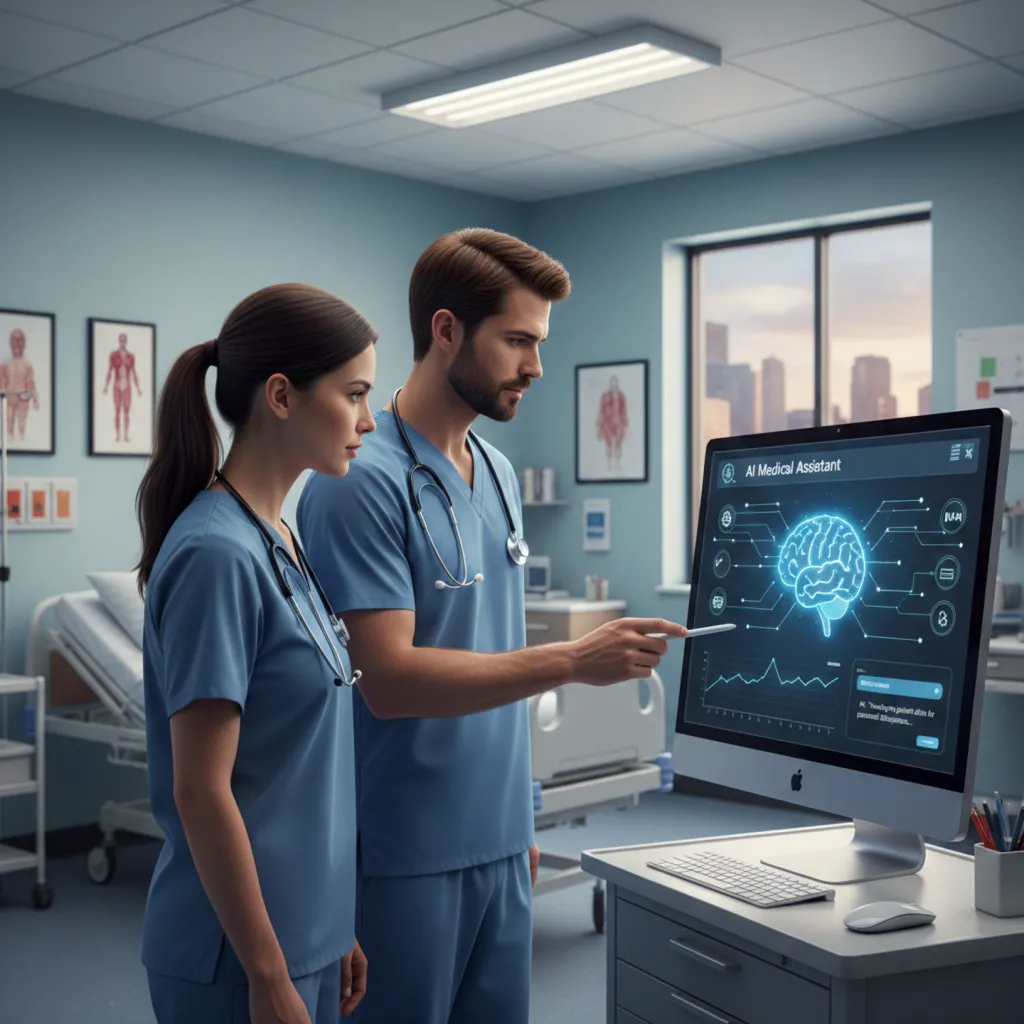
LLMs in healthcare assisting clinicians with AI-powered documentation

LLMs in Healthcare: Models & Use Case Guide

LLMs in Healthcare: Use Cases, Top Models & Safe Deployment ⏱ 12–15 min read | 🏥 Healthcare AI & Clinical Innovation | 🎯 For Healthcare Leaders, Clinical Decision Makers & Professionals Introduction: LLMs in Healthcare Large Language Models (LLMs in healthcare) are AI systems trained on massive text corpora to understand, summarize and generate human-like language. In clinical environments, they function as assistive copilots-helping clinicians, administrators and operations teams process complex medical information faster and more accurately. Healthcare data is highly unstructured and fragmented across systems: progress notes, discharge summaries, radiology reports, referral letters, prior authorizations and patient education materials. Consequently, LLMs in healthcare are most impactful where cognitive load is high and documentation is repetitive. However, LLMs can produce confident but incorrect outputs (hallucinations). Therefore, safe healthcare AI deployment requires structured governance, human validation, traceable audit logs and secure infrastructure design. At Logassa, we approach healthcare AI from a systems engineering perspective-ensuring scalability, interoperability and compliance across clinical workflows. How LLMs in Healthcare Are Used 1. Clinical Documentation Automation – Drafting SOAP notes, discharge summaries, referral letters and operative notes for LLMs in healthcare – Structuring free-text into standardized templates (problems, medications, allergies) – Reducing administrative burden when integrated with EHR systems 2. EHR Summarization & Chart Review – Condensing long patient histories into structured timelines – Identifying missing context such as pending labs or overdue screenings – Structuring free-text into standardized templates and chart reviews 3. Assistive Clinical Decision Support – Retrieving guideline snippets with citations for LLMs in healthcare – Generating differential diagnosis considerations and care pathway checklists – Assistive systems only – not autonomous decision-makers 4. Patient Communication & Education – Producing patient-friendly discharge instructions – Multilingual explanation generation – Guardrailed triage chat interfaces with escalation protocols 5. Medical Coding & Billing Support – Suggesting ICD and CPT codes from clinical documentation – Flagging incomplete notes for coding accuracy – Automating prior authorization drafts 6. Research & Pharmacovigilance – Literature summarization and biomedical evidence extraction – Clustering adverse event narratives – Summaries of data and creates analysis report Top Models of LLMs in healthcare Availability and licensing evolve rapidly. This is a technical comparison, not a vendor endorsement. 1. OpenAI – GPT-4 / GPT-4o Strengths: – High-quality reasoning and summarization – Workflow automation capabilities among LLMs in healthcare Limitations: – Not healthcare-specialized by default – Requires structured guardrails 2. Google – Gemini / MedLM Strengths: – Healthcare-focused variants – Integration with Google Cloud healthcare stack Limitations: – Enterprise-focused access – Governance required 3. Anthropic – Claude Strong long-context reasoning; useful for compliance and policy drafting with LLMs in healthcare. 4. Meta – Llama 3 Open-weights model family suitable for private cloud and on-prem healthcare copilots. 5. Mistral AI – Mistral Efficient multilingual deployment with smaller compute footprint. 6. Technology Innovation Institute – Falcon Open-weights models are often selected for sovereign or local data hosting needs. 7. Google Research – Med-PaLM 2 Medical research-focused reasoning model (limited public access). 8. Microsoft Research – BioGPT Optimized for biomedical literature generation and extraction. 9. ClinicalBERT (Clinical NLP Family) Designed for structured extraction from EHR notes and classification tasks. 10. Medical ASR + LLM Speech-to-text systems paired with LLM structuring layers for automated clinical documentation for LLMs in healthcare. Comparative Overview of LLMs in Healthcare Applications Model/ Family Medical Specific Open Weights Typical Use Case GPT-4 / GPT-4o No No Documentation, AI Assistants Gemini / MedLM Partial No EHR WorkFlows Claude No No Compliance & Long Docs Llama 3 No Yes Custom Healthcare Co-Pilots Mistral No Some Multilingual Assistants Falcon No Yes On-Prem Deployment Med-PaLM 2 Yes No Medical Q&A Research BioGPT Yes Yes Biomedical Research ClinicalBERT Yes Yes EHR Extraction Medical ASR + LLM Work-Flow Based Varies Speech-To-Notes Safety, Governance & Compliance: LLMs in healthcare Safe deployment of LLMs in healthcare requires: – Human-in-the-loop review – Confidence thresholds and refusal mechanisms – Audit logs and traceability – Secure infrastructure (HIPAA / regional compliance) – Clinical validation and model evaluation LLMs in healthcare should assist decision-making – not replace licensed medical professionals. Conclusion: LLMs in Healthcare LLMs in healthcare are reshaping documentation, analytics, patient communication and clinical workflow automation. However, real value emerges only when systems are engineered with compliance, interoperability and validation in mind. We focus on production-ready AI architecture-designed for reliability, scalability and safe clinical integration. 👉 The best time to start was yesterday. The second-best time is today-with Logassa Inc and our advanced AI solutions. Know more about our works with our Blogs. Happy Reading!

LLMs in Healthcare: Models & Use Case Guide Read More »